Tuesday, November 30, 2021

Kickin’ Orcs Old School: The Return of HeroQuest, Part II

HeroQuest, if you don’t already know, is a “dungeon crawl” game. A “dungeon crawl” typically features a small team of classic fantasy heroes exploring an underground labyrinth, encountering dangerous monsters and deadly traps which they must overcome or escape, while looting the place of all sorts of fabulous (or even magical) treasures. And if you think “that sounds like Dungeons & Dragons” you would be right— the whole idea is lifted straight from the origins of the famous father of all role-playing games. But unlike D&D, which typically places heavy emphasis on developing and improving a “realistic” fantasy character in an in-depth, grand fantasy world, a dungeon crawl just deals with the basic guts— kill the monsters, take their stuff. The heroes don’t have elaborate backgrounds or long lists of equipment. They’re archetypes— the Barbarian, the Elf, the Dwarf and the Wizard— and their abilities are largely static and unchanging. And while there may indeed be a thematic plot sold in epic hero terms, that’s really just fluff— the game isn’t about that, it’s about “shootin’, lootin’ and scootin’.” 

And that’s essentially what HeroQuest is— each player controls one of four archetypal heroes, working together as a team to defeat the monsters, complete the goals of a quest, and get out with plenty of gold. There’s no heavy roleplay involved, nor any character or world development.


The heroes are ready. The quest awaits...

Now, as I said, this game is actually quite “old,” being essentially a reproduction (and minor revision) of the original Milton Bradley game of 1989. So this review probably won’t cover any ground-breaking revelations. There aren’t any “cool” new mechanics or ideas involved. It’s old school, 1980’s era game design— but that old school style is still a lot of fun, and worth the reviving.

How It Works

Play is simple. The game can be played by 2 to 5 people (or, with the new app, solo— which I’ll touch on in a later blog). One person must be “the evil wizard Zargon,” which is really just the person who controls all the monsters and reveals the areas and surprises of the dungeon as the game goes along. The other players take on the roles of the four heroes, who must enter the various dungeons in the game and face Zargon’s vile minions. Ostensibly, Zargon “wins” by defeating the heroes— either killing them, or forcing them to flee without completing the goal of a given quest. The heroes “win” by achieving that same goal and acquiring treasure in the process. However, Zargon losing isn’t really much of a loss— the pleasure of being Zargon comes from seeing the others struggle against the challenges of the quest, even if the heroes win. So while the game is set up as oppositional, that’s not the heavy emphasis, and it doesn’t have to be played that way.


Heroes take turns, in order, performing a limited selection of possibilities: Move and take one of six possible “Actions:” Attack, Cast a Spell, Search for Treasure, Search for Secret Doors, Search for Traps, or Disarm a Trap. The action can be taken before or after moving, but moving cannot be split around an action. Two dice are typically rolled to see how far a hero can move, but the hero doesn’t have to move the full amount (and at times won’t be able to do so).

An attack is done by rolling a number of dice equal to the attacker’s Attack Strength; the target may then roll a number of dice equal to the target’s Defense Strength. The dice are unique to the game, featuring images of skulls (three of these), two white shields and one black shield. Hits are made when skulls are rolled; shield results block hits (white shields for heroes defending, the black shield for monsters defending).

Spells are on cards. Cast a spell, and it’s gone— it cannot be recovered for the current quest. Spells typically do things like heal heroes, cause special attacks against monsters, boost a hero’s attack or defense, or grant a hero a one-use special power (as moving through walls).


Once all heroes have each had a turn, the monsters take a turn, moving and attacking as the Zargon player wishes, in the same manner as the heroes. Some monsters can also cast spells.


Those are pretty much the rules, aside from some details about how traps and secret doors are handled. Treasure is found in two ways— certain rooms have unique treasures or other discoveries defined by the Quest Book. Otherwise, treasure is randomly drawn from a deck of cards— but this deck also contains surprises like “hazards” (unavoidable traps) and “wandering monsters” which immediately attack the searcher. Otherwise the whole game simply involves exploring the dungeon and dealing with what you find, then getting out.


How It Plays

I started my experience with the game playing solo against Hasbro’s new (free) HeroQuest Companion App (I have the iOS version for my Apple iPad). This app handles the role of Zargon, so that a game can be played solo (with the player controlling all four heroes), or so a group of four can play the game with everyone being a hero, and the app being Zargon. (More about the app itself in a later blog.)


At first, I’ll admit that I found the board game play very simplistic, and the initial quests very easy. But after getting several quests under my belt, I suddenly ran into one that nearly wiped my party of heroes out— we were dashing to escape with our lives hanging on by one or two “Body Points” (the game’s term for hit points or wounds, which depending on hero range from 4 to 8). Suddenly I found myself respecting this old, “simple” game.


Later, when I took over as Zargon for my friends, I was surprised to discover that first quest, which I had thought too easy, was almost a death sentence for my buddies— indeed, they did lose one hero (the Wizard) to a combination of hazards and a well-rolled monster attack. When it all ended and the Big Bad Monster bit the dust, the remainder of the team were out of spells and almost out of lives— and glad to abandon the dungeon, despite knowing they were leaving potential treasure behind.


Now, part of the reason for that is as Zargon, I play with a little better tactical and strategic sense than the app does— going for high value hero targets (like the Wizard), retreating for better tactical conditions, etc.. But my players also ran into some horrendous luck— monsters improbably blocking multiple hits, treasure searches producing more hazards and monsters than treasure, and so on. Still, even with that accounted for, the game wound up being more exciting (and tense) than I had thought— proof that once again, the old school can be a very good school!


...and the trouble begins!
Defend yourselves, brave heroes-- if you can. MUA-HA-HA-HA-HA!

What’s to Like

HeroQuest is fun— there’s no question. If you want that old school fantasy game experience and you’re not wanting a heavy evening of roleplay, negotiations, and rules minutiae, HeroQuest will certainly satisfy that itch. And unlike many dungeon crawl games— TSR/WotC’s Dungeon!, Ganesha Games’ Four Against Darkness, SJG’s Munchkin, and the various dice or card-based dungeon games, HeroQuest allows for and requires tactical thinking in combat— it matters where and how your hero moves and stands, and the equipment can allow for good tactical advantages beyond just increasing the die roll. Also, the game is simpler and purer in its approach than current popular takes like GW’s new Warhammer Quest, Flying Frog's Shadows of Brimstone, FFG’s Descent, Cephalofair Games' Gloomhaven, and the like (some of which I have played, some not). It’s dead easy to pick up, and doesn’t require reading lengthy rules or attention to heavy details. (Plus, the ability to move either before or after an action is not a trivial difference to most of these games— hit and run away is a viable tactic in HeroQuest, if not essential!)

The app (again, in an upcoming blog post) allows for the potential Zargon player to experience the quest for himself, playing as the heroes before he reads the entry in the Quest Book.


There’s a lot of tactile appeal to the game— the miniatures and the three-dimensional dungeon furnishings are terrific to look at, have a nice heft, and can be painted (though this isn’t necessary to play). The dice are unique and fun to roll— who doesn’t like seeing results consisting of skulls, shields, and scary monster faces? The card artwork is solid as well— there’s nothing to take you out of the experience of the game. There’s a special screen for Zargon to hide the details of the Quest from the players, though to be honest, it’s not all that necessary. I think it was included in the original 1989 game as a way to “look” like 1980s D&D with its famous “Dungeon Master’s Screen” element. But it’s fun, and the artwork is nicely evocative, with its depiction of a brooding wizard “controlling” his dark minions.


Playing time is quick— about an hour and a half or even less to complete most “quests,” making this a great game for quenching that fantasy thirst in a single evening. This also helps keep the player elimination aspect from being a drag on the evening— usually a hero death won’t happen until the final boss fight, so everyone stays engaged during play.


There are a total of 14 adventures in the included Quest Book, as well as instructions for creating original quests— but 14 gaming nights is a pretty good run for any adventure game. Also, Hasbro has already produced two expansion quests sets (“sold separately”), and has materials to do at least three more. (I purchased my game through Hasbro’s “HasbroPulse” crowd-funding sight— an in-house version of Kickstarter. I went whole hog, and wound up getting all the expansions then produced, with extra miniatures.)


The heroes are presented as three males (Barbarian, Dwarf and Wizard) and one female (the Elf), but the crowd-funding effort also produced counterparts to these, as well as four additional hero choices. I imagine these may wind up being sold in an expansion set, if your players want a personal connection to their heroes. It really doesn’t matter in play— nothing about the game expects male or female or distinguishes between the two, aside from some art. Otherwise, the female Barbarian has the exact same abilities and levels as the male Barbarian, and so on. And if you do collect or play other games with miniatures, you can easily substitute these for the figures included in the boxed set. (For those interested, just eyeballing ‘em, the scale appears to be “heroic” 28mm— certainly no more than 32mm.)


The rulebook is clear and easy to read. Some elements might be slightly out of place (the rules for purchasing equipment are presented in the section about Searching for Treasure, though the purchases can only happen after a quest has ended, which is discussed at the end of the rule book). But for the most part, everything is easy to follow and find. There are a few discrepancies between the text on some of the cards and the rules. For example, some spells are line of sight, and the cards so state, but others aren’t clear on that point (as the various healing spells). Also, the various “dangerous” Treasure cards say to return the card to the bottom of the deck, while the rules say to reshuffle the Treasure deck every time a hazard or wandering monster card is drawn. Which applies? My group decided the rulebook superseded the card. (I would propose putting the card on the bottom of the deck and reshuffling only after an actual treasure is drawn as an interesting house rule, but I haven’t yet tried that.) And the Dagger equipment card says it can be thrown as a missile weapon (at which point it is lost), but the Wizard has a Dagger as standard equipment, with no indication this can either be thrown or lost. We decided that dagger wasn’t balanced for throwing (or he was very sentimental about it).


The Quest Book is also well done and clear. The few “read aloud” passages are evocative, but I also recommend that the Zargon player add some flavor of his own from time to time when placing the items and monsters in a room. But that’s just my approach, and certainly isn’t required.


For Parents: Nothing to Fear

The box says the game is for ages 14+. I’m not certain why this age is set so high. The game should be easily grasped by ages 10 and up, or even with adult guidance, kids 8 and up. There’s some reading to be done, but it’s quite clear, and there isn’t any objectionable material in the game that I can see. The art and figures are tasteful, there’s no presentation of gore, and what violence there is is abstracted into dice rolls. I suppose a few of the monsters are “scary,” but on a level about as frightening as creatures in a Power Rangers episode. I suppose parents stuck in 1980s Moral Panic mode might see the Gargoyle as demonic looking, but he’s presented as a magical creature of living stone (and was back then, too), to the extent that he’s presented as anything other than a Big Boss Monster. The other foes are classic Games Workshop style goblins (little, mean and green), orcs (big mean and green), “abominations” (who look like giant fish-headed trolls), “Dread Warriors” (big men in heavy armor), and mummies, zombies and skeletons straight out of stop-motion movies like Jason and the Argonauts. There’s also “Dread Sorcerer” who is a skeletal wizard, but no where near as alarming as something in Harry Potter. So if you’ve got a kid who likes books like The Hobbit, Harry Potter, or just Saturday-morning adventure cartoons, he (or she) will eagerly embrace HeroQuest. Younger kids might struggle with what to do without adult guidance, and yes, a hero can die, eliminating a player from the game— but the eliminated player could easily become Zargon’s “assistant,” controlling one or more monsters in combat and helping to place out the various dungeon furnishings.

Lit'l Zar-zilla is ready to play!

What’s Not to Like

Very little. The one thing potentially lacking is some strategic decision-making for the Zargon player. The quests are largely static (with a few exceptions)— the monsters wait in place until the heroes discover them, and the only “wandering monster” aspect is triggered by hero treasure searches— if the heroes don’t search, no new monsters can appear. So once the monsters in an area have been defeated, there’s nothing for Zargon to do on his turn until the heroes enter a new area. Fortunately the dungeons are relatively compact, so the downtime for Zargon is minimal.


The game also requires the surviving heroes to return to the stairway where they entered the dungeon to complete the quest— but by the time the heroes have pulled off the main goal, there’s rarely any opposition to stop this movement, and the dice rolling for it becomes a bit pointless. As Zargon, I simply waved away this rolling and movement when the players indicated they weren’t going to explore further, but just wanted to escape. Since they therefore wouldn’t trigger any encounters, the game was effectively over. It seems to me an element of “monster spawning” might be good to allow for the retreat to be more than just retracing one’s steps unopposed. But that’s a quibble, and it may be that further quests in the Quest Book address this (I’m only about halfway through).


Another (minor) quibble is with the Equipment. Between quests, the heroes can purchase weapons, armor and other items to improve their abilities, all presented on cards. (There’s no supply limit on these, but one could house rule limitations based on the number of cards, if one likes). There are some nice elements here, but they feel a bit limited in scope and influence on the game. And, aside from magical items in the quests (most of which so far have been one-time use potions), there’s no other way to improve a hero— there are no experience points or “leveling up” in the core game. On the other hand, simplicity has its virtue, so this objection is, as I said, very minor and probably personal to my own tastes.


And a Good Time Was Had By All…


That’s really the standard of a great game, isn’t it? That it’s fun to play, and everyone enjoys the experience— win or lose. Under that standard, HeroQuest isn’t just great, it’s terrific. It captures the theme perfectly, both in components and game play. It’s fast, easy to grasp, yet also nicely tactical— it challenges you to think a little before and during your turn. The randomness is present, but it’s not overwhelming— the player does have a sense of control over his actions, but not over the results, and to me that combination makes for an ideal and enjoyable game.

Despite being nominally oppositional between the hero players and the Zargon player, in many ways the game is cooperative not only among the hero players but also with Zargon. Even as the Zargon player acts to fight and defeat the heroes, he’s really engaging in a collaborative effort to produce a fun fantasy experience. There’s no sense of true opposition, or any impulse for cutthroat competition among the players (not that there’s anything wrong with that ;-) ). It’s just a grand time at the table, imagining being heroes facing fearsome foes— even if one of the players controls those foes. For that dungeon crawl itch, HeroQuest is a very satisfying backscratcher.


Sew five stars on the wizard’s hat for this one.


-- Howard Shirley, aka Parzival


Oh no! A wandering goblin leapt out from behind the comfy chair! My Wizard is in peril!
Lit'l Zar-zilla: "ROAR-HA-HA-HA-HA!


Thursday, November 11, 2021

The Return of HeroQuest


Back in the 1980's, Milton Bradley teamed up with the UK's Games Workshop to create HeroQuest, a board game which mimicked the experience of Dungeons & Dragons, but in a simplified and much more limited form, at least as far as role playing was concerned.

The game involved a single map board divided into static rooms and corridors, but the whole board wasn't used in any one game. Instead, the path of available rooms and how they connected with each other was determined by set scenarios, meaning that each game would be different in play. The players took on either the roles of the heroes-- always a Barbarian, a Dwarf, an Elf, and a Wizard-- or the "evil wizard" Zargon, who acted as their opposition, controlling the various monsters, traps and tricks the heroes would encounter on the adventure. If was very much a "rules lite" copy of D&D (though not a clone by any means). In addition to the figures for the heroes and the monsters, the game included plastic items representing the various furnishings of the ruined "dungeon" the heroes would explore.

At the time it came out, I was a teenager, and looked down on it as a "kiddie" version of D&D, clearly inferior to "the Real Thing." It was also pricey, so I passed it by. The game had some success, but eventually went out of production.

It wasn't much after that when I began hearing how much fun the game actually was as just a quick-and-goofy dungeon crawl. Suddenly, I wanted the game. But it was gone forever, and by the time copies began to appear on eBay, the prices were sky high-- $300 or more for used and battered sets! I wrote it off as not-to-be...

And then in spring of 2020, I learned that Hasbro, who now owned Milton Bradley, had decided to bring the game back through their Avalon Hill line... but only as a crowd-funded product via HasbroPulse. But it was enough to convince me. I leapt in full bore, and backed the game for the full "Mythic tier" level, which would include reproductions of the original expansion sets from back in the day, as well as extra goodies if sales went well.

Sales went great. I had hit the motherlode, and all I had to do was wait a year. (Yes, I actually managed to wait patiently for a whole year. No, really.)

This past week my waiting paid off and the box full of goodies arrived from Hasbro... and I'm sharing my treasures with you-- feast your eyes!


The New HeroQuest: ALL the boxes! (Mythic, ain't it?)


Figures from the main game (also cards & character sheet pad)

The board, with Zargon's screen (still in paper band wraps).

Inside of Zargon's screen, rule books, and punch out tiles and markers.

Zargon's screen, from the heroes players' view.

Expansion quests contents-- more minis!

The "Mythic Tier" original expansion quests.
Mythic Tier unboxed-- even more awesome minis.
(Yes, that's a dragon.)

The Ladies of the Mythic Tier (plus "Lord Ragnar")


The heroes, both male and female in pairs.
Left to right: Barbarians, Dwarfs, Elves, Wizards.


The Mythic tier additional heroes, plus "Lord Ragnar."
Left to right: Warlock, Wizard ("Mentor"), Bard, Druid, "Lord Ragnar."

And there you have 'em! Aside from a few slightly bent weapons (easily correctable with hot water, a quick reshape, and a cold water shock), everything was in great shape.

Note that the sculpts and artwork are all new to the game-- homages to the original product, but not actually copies. (I suspect exact duplicates would not be possible for copyright reasons, not to mention probable destruction of the original molds.)

I'm looking forward to trying this out-- the whole thing should be a hoot!

--- Howard Shirley, aka Parzival

UPDATE

First, a minor correction: The core game has a female Elf hero and figure; the male Elf  hero is part of the Mythic tier upgrade.

Secondly, HasbroPulse/Avalon Hill has announced the game will be released for retail-- so it's available even if you didn't back the crowdfunding project.

Thirdly, and more importantly, HasbroPulse has released the HeroQuest Companion app, available for free, which can play as the evil Zargon, allowing all players to be heroes and experience the mysteries of the quests themselves. The app also supports solo play, so if you're by your lonesome, you can run all four heroes and try to defeat the dread forces of Zargon yourself! I'll be reviewing this app and the overall gameplay very soon... and in the meantime, I'm gonna have some fun!


Monday, August 23, 2021

Bilbo Comes to Nashcon (Along with a Few Friends & Enemies)

 The quest was epic, the journey was (almost) short, and the results were... a fun time.

Or to put it another way, this weekend I traveled about 40 minute north to Nashcon, the annual Nashville wargaming convention put on by the grand people of the Historical Miniatures Game Society Midsouth. There I was proud to present The Battle of Five Armies, Games Workshop's 10mm masterpiece based on the final epic battle of Tolkien's classic novel, The Hobbit.

I've discussed this battle and game before here, so I won't repeat that (but feel free to read at your leisure).

In a twist, I allowed some additional units to enter the game (one the principle that while the good professor did not mention such forces, they "could" have been present in small numbers unlikely to have been discerned by our diminutive narrator). These forces included:

A unit of elf cavalry (ithe Elfking travelled to Erebor on horseback, so a relatively small guard is fitting)

A unit of dwarven archers (implied in the battle's description and the behavior of Thorin & Co. throughout the book), a unit of giant bats (actually mentioned, at least as carrion creatures)

And a unit of hill trolls (okay, a stretch... but the sun was hidden by the massive cloud of bats, so why not?).

As it turned out, all four did next to nothing in the battle, and all but one were wiped out early on rather handily.

This battle took an early dark turn for the Armies of the Free Folk, with the Men of the Long Lake being obliterated by a charge of wargs and goblin warg-riders on the eastern side of the ford, and the elves stalling while the warg-riders seized the ford and crossed to charge the suspiciously combat-averse elves.

As the battle progressed the Free Folk struggled to make headway. Thorin attempted to rally the elves, but after initial success was overwhelmed and killed by the foe (as in the book, or close enough).

At that point, with a roll of a die, Beorn entered the fray, doing damage but not turning the tide.

The Free Folk were close to the point of breaking— one unit more lost, and they would be done.

And at that point, in true Tolkien fashion, the eagles arrived, and the battle turned. The goblins were scattered and the Free Folk had won a costly victory.

Behold the aftermath below:

The fields before Erebor, as the battle ended.

A grand fight and a fun time.

A note on my Lonely Mountain. I had carved a large piece of styrofoam, suitably painted, to be my backdrop mountain, but alas the heat and humidity of August does not allow for the spraying of even suitably foam-safe primer! 90°+F, 75%+ humidity = No foam mountain.

So inspiration hit— I would mimic Tolkien's illustrations of the Lonely Mountain. One piece of black poster board, rolled into a cone, one suitably "snowscaped" piece of white felt, some glue, and a silver Sharpie marker, et voila— Erebor, the Lonely Mountain, in the style of the master himself. (I felt that black would be more dramatic than white, and better suited for the daytime scene of the battle.)

My inspiration: Tolkien's illustration of the Lonely Mountain.

The rest of the convention I spent as a player (and shopper). But the above was my contribution this year— and who knows; this battle (or another) may well appear again.

— Howard Shirley, aka Parzival

Monday, April 12, 2021

The Return of the Hobbit-- A Good Friend Fights the Battle of Five Armies

Winter is done, the sun is up, and what could be better than having a friend in for a little gaming?
I can't think of anything!

So my friend Lon over for an evening of food and gaming, and surprised him by setting up Games Workshop's The Battle of Five Armies, one of my absolute favorite miniatures games.

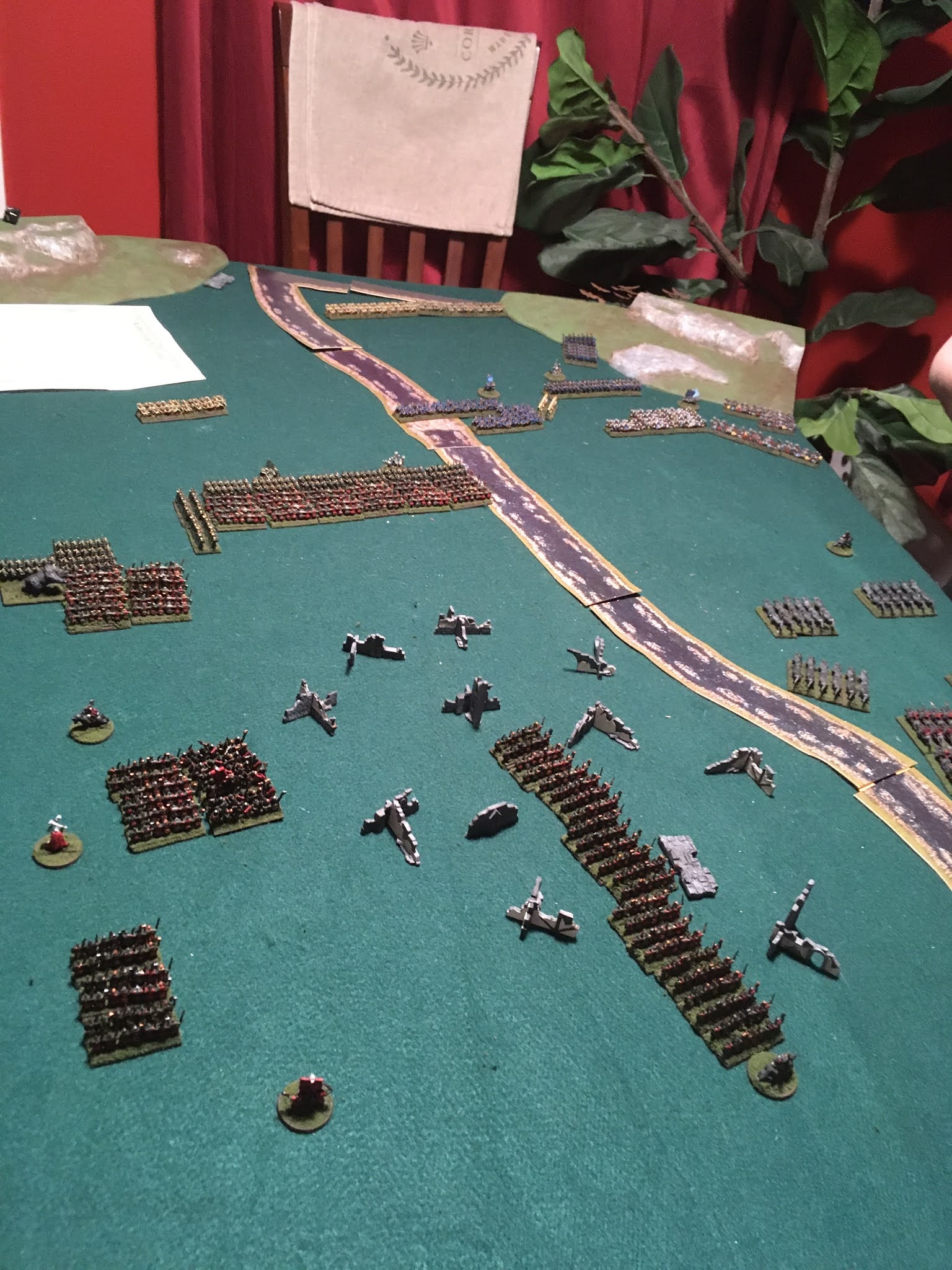
Published back in 2004, this boxed set game is a variant of the company's Warmaster rules system, designed for 10mm scale figures. The set included the eponymous armies in plastic, plus two very nice hill quarters, terrain (the "Ruins of Dale") and a printed cardboard river set. Additional metal figures could be purchased separately. At the time the game value was high-- one of GW's best efforts, hands down. But the game was almost abruptly discontinued. As a result, I was able to score two copies before anyone caught on as to how great this thing was-- today's prices are in the "lost limbs" category.

Oh, you big, beautiful box (plus a few extras Not Appearing In This Battle).


But enough of that, and on with the play.

Lon's familiar with miniatures from his D&D days, but the Warmaster system was entirely new to him. He knows of Warhammer, and immediately realized they shared an ancestry (though the games themselves are very different). But for this game, he was entirely a newbie.

The set up should be familiar-- Smaug the Terrible is dead, and the news has brought plunderers to the Lonely Mountain, eager to claim his treasure, some for generally good purposes (the Elves and Men, seeking to recover from the destruction of Laketown), some to protect ancestral rights (the Dwarves), and some just because it's there for the taking (the goblin). And so, between the arms of the Lonely Mountain, beside the River Running and through the ruins of Dale, the foes encounter each other-- with the Dwarves, Elves, and Men realizing that their legal disputes can't be resolved if they're all dead.
So while the name is "Five Armies", in effect it's just two-- the Good Guys vs. the Bad Guys.

The Bad Guys, with some other Extras Not Appearing In This Battle
(Especially Smaug, who's technically dead. Or mostly dead.)


Lon chose command of the Goblin Horde, which is a good choice for the novice-- they're a straightforward army with not a lot of details to recall, but with some nifty advantages. It consists largely of a whole lot of (weak) infantry ("Goblins"), a single unit of heavier infantry ("Goblin Guard"), and cavalry in the form of Wargs and Warg Riders, the former of which hit harder, the latter of which have armor and 360° shooting ability. Added to this are a boatload of "heroes"/"officers" to issue orders, a single goblin shaman (to cast helpful spells), and the general, Bolg of the North. The goblins begin with all the cavalry on the field, though constricted to the narrow strip east of the River Running. The bulk of their army will arrive piece-meal, based on a die roll at the start of each turn. They will enter on the western side of the river, from the south edge of the battle field, with the ruins of Dale between them and the opposing forces.

I took the ad hoc Alliance of Free Folk, and placed my armies first, restricted to arranging them on the mountain spurs, elves on the western spur, men and dwarves on the east, pretty much by the book. The spurs are a defended position by the rules, making the forces on them harder to hit in combat, but it's a trade-off, as the goblins, following the novel, are able to secretly scale the heights and toss rocks, spears and other nasty stuff on the defenders below, and get to keep doing so until (and if) the eagles arrive.

The Battle Begins... With a Yawn.


The battle is played in 8 turns maximum, of each side going in order, Goblins first. Lon quickly got a good portion of his infantry on the field, and tried to send his cavalry forward, but his officers were inept, and their advance (such as it was) stalled.

I ordered my forces off the spurs, and to some extent the elves responded. I maneuvered to link across the ford with the men and dwarves. However, the latter forces (especially the men) were quite comfortable on their rocky heights, and refused to believe any rumors that the goblins could possibly claim even higher ground. For some, this refusal continued later in the game, even as stuff whacked 'em on their heads.
Quoth the Dark Lord: "Why won't you move?"

Turn the Second: Errybody 'Ere? Charge! Or, er, Mebbe Not.

The Dark Lord Lon started off the second round with a remarkable die roll, introducing his entire remaining force to the battle (and thus getting to drop stuff on those foolish Lakemen's heads).
But with his forces assembled, apparently assembling was all the goblins thought they were required to do. He was able to advance his infantry a bit on his left, but the cavalry pretty much sat there and blinked.
Some fancy maneuverin'!

The Long View


Turn the Third: Hey, I Think That's the Enemy Just Yonder.

Not much happened here for either side. The goblins were able to achieve a moderate advance, though the bulk of the cavalry still held back. The elves realized that a withdrawal across the ford wasn't going to be possible, so opted to extend themselves into a long (thin) line to prevent a flanking maneuver from the oncoming goblin horde, covering the ford as well. And the two forces stared at each other across the countryside, exchange insults and little else.
The Dark Lord; "Well, at least I can drop some rocks."

Hmm... looks like a half-time show...

Slowly... slowly... really slowly...

Turn the Fourth: Let's You and Him Fight.

Finally! Some contact!
Giving up on their recalcitrant allies, the wargs surged forward on their own initiative to strike the line of elven archers who had crossed the ford. Wolf bites can be mighty nasty, and these were. One entire unit of elves was destroyed, and another barely survived with a third of its members, being forced to retreat back to the safety of the dwarves (certainly of much amusement to Durin's folk).
Across the ford, the goblins maneuvered to threaten the elven flanks, if they could, but this time the infantry faltered and failed to press the attack...
Elves down! Elves down! We need backup!

The horror! Oh, the... uh... elvenity!

Turn the Fifth: The Elves Call the Shots

With a goblin forlorn hope over extended on the Elven center (near the ford), and another looking to flank their right, the elves advanced into battle. The goblins in the lead were quickly overwhelmed, though not without elven losses, and the elven line extended on the far right to prevent the flanking. What would happen next?
The Elves find an answer!

Turn the Sixth: Thar's a Bar! Whar? Ova Thar! 

And then the dice fell the Good Guy's way— Beorn entered the fray! Charging in on the goblin left, he tore through the would-be flankers like... like... well, like a ginormous bear through a pack of goblins. Goblin corpses flew left and right,  their blood slaking the thirsty ground, their bodies lying about like... okay, many many stands were removed, and the advancing goblin line was thoroughly whacked, confused and forced back before the bear retired a bit to rest and reconnect with the now advancing elves.

Meanwhile, on the Good Guy's left, the dwarves decided it was time to smack some wolves about, and stormed off the mountain slopes, backed by the men of the Long Lake, and aided by the remaining elves. The fur flew, and the wargs fell— four entire units wiped out by the swirling axes of Dain's people. "Baruk Khazâd! Khazâd Ai-mênu!" "Yipe! Yipe! Yipe! Whimper..."

Bear grills goblin. What a mess!

Turn the Seventh: Thorin! Thorin!

And with that, the Gate of Erebor crashed down, and Thorin, in his gleaming armor, joined the battle. Even the elves were impressed with his kingly bearing, and he took command of a unit of spearmen, eager to follow the bearded one into combat. The Elfking also took command of another unit, and once again the mighty Beorn surged forward as well. The goblins rallied to surround the bear, hoping that slaying the beast would turn the tide... they succeeded in the former, but not the latter.
Elves and Dwarves and Bear, Oh... no we are NOT making that lame joke.


Another view of the big Bear, Elf, Dwarf and Goblin fight.

The Final Chapter: The Death of Bolg

In a bold move, Bolg himself joined the fight, sending his Goblin Guard forward in a risky fight— but they were not enough to withstand the fury of Thorin. Down fell the goblins, and down went Bolg— perishing upon the spears of the elves and the bloody axe of Thorin Oakenshield.
And thus falls the big ugly orc.

Their commander dead, their forces in disarray, the goblins panicked, and fled the field.
The King Under the Mountain had won the day.

The Eagles' View... having arrived too late to do anything but take beauty shots of the aftermath, those fickle-feathered flappers.

Conclusion: A Fun Fight and a Promise
So we had a terrific time. Lon loved his first exposure to the Warmaster system, and we made promises to return to fight again. In the end, it's not the outcome of the game that matters— it's time with friends that makes the difference. My prayer for all of you in this time of separation and anxiety that you can find ways to overcome these, in person if possible, or via the many online opportunities.

So, thanks to Lon for a great fight, and hope for all for many more battles (of the fun kind) in the future!

Sincerely,

Howard, aka Parzival


Tuesday, March 9, 2021

A Delve Into Memory Lane-- or the Dungeon of Nostalgia

 Long ago in days of yore,

when dragons slept on golden hoards,

some bold young lads took swords in hand

to slay great beasts and save the land.

With goblins, ghouls and orcs their foes,

'gainst vampires vile, and evil toads,

(and some times both at once, 'tis true)

they fought them all for gold and glory,

heroes of their own grand story—

warriors, wizards, priests and knaves,

elves and dwarves and halflings brave,

Adventurers all, a fearless lot!

(But ready to run if things got hot.)

Within their minds great realms unfurled

bold conquerors of a new-made world

a land of dreams and dreamer's hearts,

a place that lives forever part

of boyhood joys that never end--

the memories of the best of friends.


-- To James, Brook, Mark, Paul, Bill, Frank, Jimmy, Mike, Bert and David.

And the only illustration possible:

Dungeons & Dragons Basic Set, 1979, box and rulebook.
Delving into my memories, a recently acquired copy of the edition that started it all for me— the famous "Holmes Blue Book" Dungeons & Dragons Basic Set (3rd printing, 1979). It even has the remnants of the original chit sheet and a sales flyer! Cue memories of chasing chits in the wind when we played at the picnic table in my backyard, before finally acquiring honest-to-Gygax polyhedral dice.


Thanks for the memories, all! May our deeds of glory remain forever in our hearts.

-- Howard, aka "Dunjie"

Thursday, December 24, 2020

Pandemic Painting

Greetings fellow lockdown-cabin-fever sufferers! 

Well, I finally realized that I could use all this externally imposed downtime to tackle the lead pile. Painting is not my favorite element of this hobby— I like to have painted more than I like to paint. But it can pass the time, especially when watching this bizarre sports season, where I only half-pay attention to which NFL/College team which I don't root for beat up some other NFL/College team I don't root for either. Great for painting, or at least getting hobby stuff done.

So far, this is what's happened before my brushes surrendered to chaos:


These are all 10mm scale, mostly Copplestone Castings' fantasy line, with one Games Workshop 10mm Dwarf Archer unit from their OOP Battle of Five Armies line on the far right, between the cavalry and a unit of spearmen.

The units are, from left to right, starting with the front row:

Half-orcs (Uruk-hai) with Swords (three units), Half-orcs (Uruk-hai) with Spears (two units), Horse Tribe Horse Archers

Rangers (Dunedain or Ithilien, take your pick)

Horse Tribe Foot Archers (two units), Dwarf Archers (one unit)

Horse Tribe Infantry (three units)

The half-orcs currently have bare bases because I'm going to use sand for their "ground" rather than grass, and I don't have any sand in the house. Though I admit the basic black look is growing on me. Hey, they're Saruman's Army, so the whole black thing works for them.

I'll post more detailed closeups of each in the future, but for now not a bad little painting run (for me, anyway).

--- Parzival, the Wargamesmonger

Wednesday, June 24, 2020

The Sound of Stone

So I've gotten back into D&D again lately, and as I was looking back at some older stuff of mine, I turned up the following bit of short fiction, by yours truly. I hope you enjoy it!

--- Parzival, The Wargamesmonger

The Sound of Stone 
A Story of the Dwarves

by Howard Shirley

When you can’t hear your own breathing is when you realize you can miss it. I do not mean when you don’t hear your own breathing; that happens all the time. We are so used to it that we dull it out and think of it as silent, just as we don’t really notice the sound our skin makes brushing inside our clothes, or the way leather creaks as it twists against our movement. Thor knows, I’ve even ceased to notice the scrape and dull jangle of my own armor on a long march. I put it on and as far as my ears are concerned, I might as well be wearing spidercloth. Unless of course there’s an enemy nearby with ears that will pick up even the slightest scratch of my axebelt against my hauberk— then every sound I make might as well be the slam of a hammer against hot steel.

I’ve heard men like Brom say that even wrapped in breastplate on top of mail, we dwarves are quieter than cats. I don’t know whether that’s true or not— those Loki-cursed things creep up on you to yank your beard, even when your ears could hear the ring of gold in a clay cup twenty shafts away. No dwarf is that quiet or that sneaky.

Except me, right now. I glance down at the quarrel in my crossbow. It doesn’t look any different from the other bolts stuck in my belt. You’d think it would glow or even gleam, like a dwarf craftspell would. But it doesn’t look one bit different— just black, with only the faintest hint of a glimmer from the sharpened edges I honed yester-morning. The only thing that tells me Thalin’s spell is on the bolt is that I can’t hear anything— not my armor, not my leather, not even my own breathing or the pounding of blood in my temples. Even the vibrations of my feet against the floor are missing, sounds I’ve always felt with my body even if my ears have tuned them out. I can feel the rise and fall of my breath shoving my chest against my hauberk. I can feel the weight of armor and pack, the warmth of the crossbow’s stock against my hand, the tension in the trigger, even the pressure of my booted feet against the stone floor. I can smell my sweat and Brom’s strange human odor, and the hints of incense that drift from Thalin’s robes, even the tiniest tint of blood that lingers on Mada-Thor’s knife blade from this morning’s sacrifice. If I turned my head to look at them, I would see them all, stepping behind me, instinctively trying to be silent themselves, though with the magicked quarrel there is no need. In this shell of silence, I can’t hear them any more than they can hear me, or even their own breathing.

It is a . . . disquieting feeling, which seems an odd word to use given that silence surrounds us utterly. But there it is. And for an old dwarf like me, used to gauging the soundness of stone and shaft by the echoes and creaks no one but my own kind can hear, it begins to approach terrifying. “May you hear no stone,” is an old dwarven curse, a wish for disaster to befall another. Deafness among my people is like a death, for it means one can never travel alone again into the mountain ways, but must be guided as if blind, or spend the remainder of ones long years above our sacred delvings, forever an outcast amidst our kind. It is not a curse said lightly.

Yet here I am, under just such a curse by my own agreement, if however temporary. And the thought comes to my mind, What if Thalin erred? What if the spell lies not upon my quarrel, but upon my hand that held it up? I know that man’s magic is not always permanent without great labor by a mage, but dwarf and magic goes not well together, save for our own craftspells. I once heard of a dwarf who had permitted a human mage to give him wings, and instead his beard turned into feathers. If this magic of silence dwells now forever upon my person, I am cursed beyond all dwarfdom. It had seemed like a clever, even crafty idea at the time Thalin suggested it, but now with not even my own thoughts entering my ears, my fear arises that we may have mined into loose shale, as the saying goes.

Even though the pressure comes through hauberk and jerkin, the hand upon my shoulder makes me jump— I almost pull the trigger on the bow on the spot. I turn to look; it is Mada-Thor who has touched me. The look in her eyes says she understands my discomfort, she who has been my friend since before Brom held his first sword. In the overwhelming silence she can only gesture upwards. I follow her eyes, beholding the black scrawl against the ceiling, a crude sigil of a misshapen skull, cloven in two. The Damned Ones must have stood upon each other’s twisted backs to scribe it there. I am ashamed that I, a dwarf within my native realm of stone, did not see the khohbhauluth sign first— but then, Mada-Thor is guided by a god. I see Brom and Thalin turn their eyes upwards as well, and Brom mouth out the man-word “Kobold!” though not even he can hear his exclamation. Just as well— I hate hearing our sacred tongue corrupted in another’s mouth, and his cry might have alerted our quarry. For once I bless Thalin’s ploy— in one respect, it is serving us now. Brom starts at not hearing his own words, then I can see it break upon him that his outburst would have proved dangerous. He throws his head back in mirth and slaps Thalin upon his back. The mage startles at the blow, then his mouth splits into a sly grin. I like a mage with a sense of humor about themselves— all too many laugh only at the discomfort they can cause to others.

Brom shares Thalin’s grin and nods to me to advance. I’ll say this for the man, he may not be as cautious as need be, but he doesn’t swagger forth into the lead like those fools who think their bulk is proof against all comers. Brom has an inkling for tactics and a respect for where others’ abilities may be more useful than his own. In my case, I’m familiar with the nature of these passages. And I’m the best shot in the Twin Kingdoms, Above and Below, if I say so myself— even in silence.

I glance at Thalin. He needs no explanation, and waves his hand in an odd caress across the rough-hewn crystal atop his staff. The glow from it fades to a dull glimmer. My eyes adapt quickly to my native dark; yet I worry that perhaps even those faint beams may be too much and reach the khohbhauluth with warning. But no, even the sigil cannot be seen. I turn back to my companions. Brom has his sword out now, fine make for man-work, held cautiously wide to avoid the rest of us. Mada has her hammer ready, mouthing silent blessings over it— I wonder if Thor can sense her prayer, devoid of sound? I think one of my own for that, not much considering the irony. Thalin merely places one hand on Mada’s shoulder for guidance, she does the same for Brom, who moves forward and places his free hand on mine. We move off, the deaf leading the blind through halls of stone— how my clan folk would shudder at the thought!

The way is windy and slopes downwards. My eyes and feet pick out signs of loose rock, the faintest pebbles, and my fear rises at not being able to hear the faint shift of stone that warns every dwarf of a coming cave-in. This movement with half my awareness lost is almost beyond bearing.

I feel the faint change in the air current on the edges of my beard before I see the light. It is not the strange whiteness of Thalin’s staff, nor the warm yellow of dwarven fire— it is orange and sputtery, barely giving glow where it licks against the stone far ahead. But the air moves towards it, drawn towards some thin shaft that must serve as a flue. The kobolds are burning bhakhumen. It gives poor heat and poorer light, but for Those Who Chose The Blackness it is the light of ritual. It is the light by which they take blood.
The odor reaches my nose now, despite that the air moves away from me. Instinctively my voice tries to growl in disgust, but I feel only the rough movement in my throat. I tap Brom’s hand on my shoulder quickly, to tell him we are there, then move my hand back to the trigger.

We step forward slowly, only because the others cannot see to move faster. The dull glow from the bhakhumen fire grows more, and I can see that it comes from a side chamber along our way. Strange shadows move across the glow where it hits the wall opposite the chamber— the kobolds have begun their rite. My beard prickles at the thought we may have come too late.

I race forward, crossbow at the ready, no longer concerned for my companions— even their Above eyes can see the light from the chamber. Stepping into the opening, I see the scene. A score of khohbauluth are dancing before a crude altar of jumbled stone. My sister Kima is stretched across it, her chest bared below her beard, her garments ripped and stained with blood— not hers, I know— the kohbauluth send their sacrifices on unsullied. Her eyes stare upwards at the jagged obsidian blade held aloft over her breasts. She does not blink or show tears— she is a dwarf. All this I see in the instant, just as I see the khohbaulutavak, the priestess who holds the blade.

I shoot, the bolt racing across the room, and suddenly a cacophony bursts upon my straining ears— Brom in mid war cry, Mada calling upon her god, the kobolds’ chanting, the latter suddenly growing less as the bolt appears in the priestess’s shoulder. She lurches back, the knife falling from her hand to shatter silently against the floor. I drop the bow and reach for my axe. The foul creature recovers and reaches up to clasp her wound, her mouth moving to call upon her demon magic for healing— and then her eyes flair wide when she realizes her dark spell makes no sound. She grabs desperately at the bolt, but the flared head is stuck fast in both mail and flesh.

I grin, letting her see the teeth behind my beard. “May you hear no stone,” I growl, and rush to battle, my axe singing gloriously to my ears.