Tuesday, August 23, 2022

What I Did This Summer, or at least last weekend

 Just a brief moment to share some photos from the local gaming convention, Nashcon.

A Battle for the Ages

The Lonely Mountain and the armies awaiting deployment.

Once again, I ran my Battle of Five Armies 10mm game, which went over well-- despite one player experiencing an incredible series of failed common rolls (he began the game rolling boxcars! But I had already decided to take pity on the players, and did not apply the blunder rule).

Maybe if you switch dice,
oh mighty Goblin Lord David?

You may notice a difference between this year's scenery and last years-- with the inclusion of the lower mountain wall and the Great Gate.

I also shortened the field slightly, which brought the Ruins of Dale closer to the mountain, and resulted in considerably more conflict going on within the rubble, making the ruins a bigger factor in the game.

The Elf King abandons the mountain spur to confront the goblins in the ruins,
and block the ford— a good strategy, as it turned out.
(The gold dragon is but the memory of Smaug, used as an Active Player token.)

Early in the game (Turn 2), the Elf King and Bolg share taunts, 
while Bard and Dain hold to confront the East assault of the wargs and warg riders.

As was fitting, the battle's results were not decided until the 8th and final turn of the game, when Bolg's horde reached its breaking point. In a surprising twist, Beorn and the Eagles barely entered the game, and had no impact on the outcome. Instead the Elves, Men and Dwarves did the job, virtually unaided except by a single Elf cavalry unit (hey, the Professor never said they weren't there). Said cavalry wrecked havoc in a suicidal death ride through the goblin rear— they were eventually sent to the Halls of Manwe, but many slain goblins paved the road.
The Men and Dwarves slaughter their furry foes, while the Elves at the ford harry their flanks with missile fire. Note the Eagles have entered on the far west... but their only act was to drive the goblin ambush from atop the mountain's eastern and western heights.


The fight is all but done; Bolg's forces break, and flee. The West will be safe for many a year.

So a good, desperate fight, well enjoyed by all.

A Pirate's Life for Me (or a few hours of it)!


Yo ho, yo ho— it be pirate time!

After running that game, on Saturday I took part in David Raybin's always entertaining Pirate extravaganza.

Behold me fine ship, me hearties!

Nay, not that ship... this one!
(When the tavern is closing, ye take the wench ye find.)

Some broadsides are exchanged.

What be I doing, waffling about between two vessels set on blasting each other to Davy Jones' Locker?
Avast ye, there! Loosen the boom! Ready about! Helm's alee! And other nautical things!

Avast, you scurvy lubbers! Come back and fight like sea dogs!
Ah, and well— best be turning with the wind.

Alas, being limited in my speed and facing on-coming winds, I got in only a handful of licks before the main battle slipped me by-- but in an attempt to turn to join the defense of the Red fleet's home base, I was able to fire my tiny broadside into none other than the Black Pearl herself (flagship of the vile Black fleet), and scored a critical hit that jammed her rudder for a while.


Ah hah! I have ye now, ye big black bastion of blazing broadsides. Take that!

With my own vessel heavily damaged, and the Black feet fighting to return with their stolen treasure, I opted to ram their speediest vessel, and then got rammed in turn (by accident) by me own allies. Bit of a traffic jam there. 

If ye go down, go down fighting! Sing me a hymn, my lads—
 maybe the Devil will think me the chaplain.

The whole contest ended in a draw, to which I like to think my heroic sacrifice helped force. (I like to think that, and therefore I shall. "It be me truth, matey, and I'll keel-haul the lubber who says against it!")

Yes, clearly I have carried the day for my side.

A fun day, a good convention... can't wait 'til next year!


--- Howard, aka Parzival


Tuesday, February 1, 2022

My Latest Adventure: Painting the New HeroQuest Figures!

 In this blog I've shared some of my miniatures painting efforts. Up until now, I've worked almost solely with 10mm fantasy figures. It's an easy scale, as block colors and a dark general wash are sufficient to produce decent results on the tabletop. I've honestly been reluctant to attempt larger fantasy figures out of concern that I'm not skilled enough as a painter to produce decent results. But I've begun playing this game with friends over a Discord video channel, and since part of the charm of HeroQuest rises from the miniatures and scenic pieces. After two games with bare figures, I want to surprise my gaming buddies with some gaming eye candy. So I decided to face my fears, take up my paintbrush, and enter the painting dungeon... 

Did I succeed in my quest? I'll let you be the judge— no, wait, I won't. This ain't a contest. I wanted to produce a look that was GETGW— Good Enough To Game With— and I wanted to GEOTT— Get 'Em On The Table. With "arms length quality" as my goal, I knew I wouldn't be doing much in the way of highlights or shading. But I figured I could indeed pull off that quality.

Here are my results. 


Our heroes assemble for inspection!

This better be the only time you show 'em your backsides!

Skeletons, zombies and mummies— oh my!


A torture rack, a vile altar, and surely that's just a statue in the middle, right?

Oh no! Not the comfy chair!
Plus a nice weapons rack (or a rack of nice weapons) and an Alchemist's table.
Gulp— I hope that's just red ink...


Two bookshelves for perusing, and a cupboard.
I'm sure there's nothing dangerous lurking in there.


These dread creatures are still "orcs" in process.


A dungeon of color!

For the above images, while you can peruse them closeup, that's not the effect I was going for— these figures are intended to be viewed while seated at a table, or about arm's length, which is honestly how I recommend anyone approach painting miniatures. Yes, on the 'Net you will see gorgeously painted figures with subtle shading, highlights, and faux lighting effects done with paint— and if you've got that kind of talent, more power to you. But to my fellow "I just want to play" gamers, don't be afraid to just do what works for you. My approach was to come up with a few key colors and stick with those. I think I did fairly well. Good enough for me, anyway!

I've still got more to paint (I bought the Mythic Tier set, which has a LOT of figures— plus there are all those bloomin' doors (literally blooming-- for some reason they're all sculpted with vines growing on 'em. In a dungeon underground with no sunlight. I may just ignore those...

In any case, I hope you enjoy the eye candy.

-- Parzival, aka Howard Shirley

Thursday, December 23, 2021

Appy Adventuring!: The Return of HeroQuest, Part III

I mentioned in my previous posts that Hasbro has released the HeroQuest Companion App for the Apple iOS (and Android as well). The app functions in place of the Zargon player, revealing the dungeon as the heroes explore, then moving and attacking with the monsters on the Zargon turn. As I was preparing to play with friends, and yet also wanted to experience the adventures spoiler-free for myself, I was happy to give this a whirl.

Is that Mentor or Zargon? Maybe it's both...

 The Good

The quest begins. And it's awesome looking.
The app is gorgeous. It faithfully reproduces the board game map, and puts a layer of “mysterious green haze” over the unexplored hedges, which undulates like clouds. Everything is shown in a top down view, in two-dimensional art. The various furnitures pieces are seen in this way as well, but the designers included some clues as to what piece is represented when it’s not clear— for example, the two bookcases will have a lone book resting on top, whereas the otherwise identical cupboard top has no book. Similarly, the fireplace has the glow of the fire on the hearth. (Otherwise these particular objects would be a little generic, compared to the others which have better visual appearances from an overhead perspective.)

The heroes and monsters are represented by icon tokens rather than figurines. For the heroes, the icons are the head and face character portraits from the cards; for the monsters, the icons match the small icons on the various monster cards (only as full color illustrations). The monsters also conveniently show the number of defense die to roll for these creatures when a hero attacks one. Clicking on a monster brings up a copy of the monster’s stat card, with a function for adding damage or an outright kill.

Each quest begins with the introductory text read by “Mentor,” with a suitably effective voice narration. During the game, the melodramatic voice of Zargon either offers instructions or taunts and threatens the heroes, with appropriate sneers and evil laughter. The sound elements also include thematically moody “adventuring” music, and sound effects for traps, item placement, monster attacks, and so forth. The voices, music, and sound effects can be independently adjusted in volume, or silenced completely. It all works quite well for the mood of the game, and feels a little like a throwback to old school fantasy movies of the ‘70s and ‘80s.

How It Works


The HeroQuest Companion is easy to use. First the player is invited to choose either an already existing party, or create a new one— the first time around the only option is to create a party. The player selects the heroes to use, in order, which will establish their turn order in the game. The app supports not only the classic original heroes but the three expansion heroes (Bard, Warlock, and Druid) and the various different imagery from the game, including the alternate hero genders and the classic “Mentor” wizard appearance— although like the board game, the appearance has no effect on actual play. Each group can be given a unique name, and the progress of a group will be saved independently of other groups, potentially allowing multiple solo players to share the app. (I created one party to experience the various quests, and a second party simply to test the app’s features and idiosyncrasies.)

Once the party is created, the app offers the choice of Quest environment— the standard Quest Book or the two Expansion Quest sets, though neither of these are available at the start, but will appear as free in-app updates. (There’s no sign of the special Mythic Tier Quest, alas. If as I suspect this quest is eventually offered as an expansion, I hope it will be added to the app as well.)

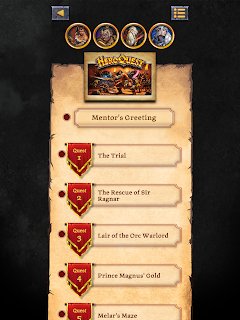
With the environment selected, the player is given the lists of quest to choose from, which can be approached out of order if one wishes (I don’t advise this, if you want your heroes to survive!). Once the player taps on the quest, the app loads the board revealing the opening chamber for the quest and instructs the player to set any pieces on the physical game board. When the player indicates that this has been done, the app brings up a title screen with an introduction for the quest, which is also read to the players by “Mentor.” (The reading can be skipped at any time). After this, the app may also bring up further details about the quest, such as special monsters, quest goals and objectives, and any special instructions needed to complete the quest. Most of these will include illustrations just for flavor.


From there, the app’s use in actual play is simple. The current hero is shown in a small menu at the bottom of the screen, which itself has two buttons— “Move Help” and “Action.” Other heroes may be activated by tapping either the token on the map, or tapping the four hero icons displayed at the top of the screen.
The Move screen.
You've seen it. You may now ignore it.
The “Move Help” button merely calls up a help screen which describes how to move— once you’ve read this, there’s really no point in tapping this button ever again. Movement consists of dragging a hero’s token along the path to his new position. The app springs traps according to this movement, if any exist and have not yet been disarmed. If a trap is already known, the app will give the option to jump the trap or disarm it. Otherwise, all Actions are selected from a list called up by a tap on the Action button for the active hero, shown at the bottom of the screen. The app will hide buttons for actions which cannot happen due to circumstances in the game. Note, however, that certain Actions only trigger an instruction to draw an actual physical card or roll the physical dice— the app does not replicate these elements for players, and so can’t actually be played as a game without using the real board game (one could skip the board and figures, but not the cards and dice). In fact, there is no button for attacking, just a “?” icon which instructs the user to roll the physical dice for the hero’s attack as well as for the monster’s defense. After this is done, the player taps on the monster token and tells the app the results of the attack (if any). The app then tracks the damage and alerts the player if the monster has been defeated, instructing the player to remove the monster from the board.


The Action Screen for a Wizard.

Once all heroes have completed their movement and actions (or have opted not to do anything), the player taps “Zargon’s Turn” to allow the Zargon AI to take over. The Zargon AI moves the monsters, alerting the player to also change the monster’s location on the physical board. Monster attacks, unlike all other dice rolls, are made by the app— but the player still rolls the physical dice for the hero’s Defense roll.

The Attack Screen. Yeah, you may now ignore this, too.


 Spells are also handled somewhat oddly— some spell effects are carried out by the app, with the player tapping on a target. If a spell which has a potential “break” roll is cast on a monster, the app rolls virtual dice to attempt to break the spell. If the monster fails this roll, the app automatically tracks the effect on the monster. However, if a monster casts a spell on a hero, the player rolls the physical dice to attempt a break. The app also checks line of sight for most spells— but for some spells the app simply instructs the player to “follow the instructions on the card,” with no indication as to whether the line of sight is blocked.

The Spell Screen. This one is useful!

Special Features

The app has a save function which can be used mid-adventure to save the state of the game, which is a nice feature. Be aware that unless you save, you will lose all your progress if you put your device to sleep mid-game (as closing a cover on an iPad). Fortunately, the app automatically saves the heroes’ progress through the list of quests, so you can always at least return to the start of the current quest should something interrupt your game before you can save. Note, however, that the app doesn’t track any details other than location and the status of traps and monsters, as well as any searches conducted. It doesn’t track treasure found, hero Body Points, spells used, or any other hero details— these are all assumed to be tracked by the players on the heroes’ physical character sheets.

Dinner's ready— save your heroes!

During play, the app can be set to show the wounds on monsters by adding little skulls to the monster tokens, which mimics the token stacking done by Zargon in the physical change. This feature can be turned off if one likes to keep guessing (though really there doesn’t seem to be much point to turning it off). If a player has trouble with the quest the app can also provide “hints” from Mentor. Tapping the banner emblem at the top left of the image will bring up first a summary of the quest’s goals and special rules (if any). Tapping the Hints button will produce a screen with a series of “?” icons. Tapping on these reveals text with clues or even outright explicit directions to find the quest’s various objectives. (I never found cause to need these, but then I’m a pretty savvy dude.)

One quirky feature of the app is the ability to turn off furniture, allowing players and monsters to freely move through these details as if they were intangible. (Apparently this was how some fans played the original game; I prefer the tactical restrictions provided by the physical presence of these items— though see the Line of Sight quirks below).

Quirks and Problems

The app has a number of quirks which hopefully will be corrected. Movement of heroes in the app will produce a trail of numbers counting off the spaces— which is helpful— however, the movement isn’t limited by the app. You could ignore your dice rolls and move any given hero an unlimited number of squares on a single turn (I got up to 56 squares on a test check before I stopped— the app never so much as blipped). The plus to this is that when a scenario is completed and no other actions can effectively be taken by Zargon, you can simply drag each hero token along the path back to the staircase and ignore dice rolls. Of course, a “skip to return” feature would be nice so you don’t have to drag the tokens at all, but that’s a minor quibble.

Spell handling is one area where the app has a significant problems. First, the app treats line of sight differently than in the rules. For example, despite line of sight being allowed when looking diagonally through an open doorway, the app will at times declare there is no line of sight in this manner for different spells. Also, line of sight is blocked across any furniture— including low lying pieces like tables and chests, which seems unnecessarily restrictive and unrealistic. At least one spell— Pass Through Rock— can be cast on a hero who has already moved. By the book the spell effect will linger to the character’s next movement turn. But the app unfortunately forgets the spell once Zargon’s turn has activated, so if you wish to cast the spell on a hero whose turn precedes the spell caster’s turn, you’re out of luck. (This one really needs to be fixed, as unlike most of the errors, it can actually affect your game play negatively.) Another spell, Genie, has two uses— either opening a distant door, or conducting a 5 dice attack on a target in sight. However, this spell doesn’t work in the app for targeting monsters. If a closed door is present, you will be offered a choice to click the “Open a Door” button or Cancel. But even if a monster is clearly present and visible, the spell reports “No target in sight.” I just ignored this and rolled the dice anyway. Finally, in one of the quests (#8), a monster cast a spell on one of my heroes, and the app produced a spell card image that should have explained the spell and the action to take, but instead only read “New Text.” Oops.

Note that the app also doesn’t track hero spell usage at all. Your Wizard or Elf can cast the same spells over and over again, and the app doesn’t bat
an eyelash. You could also have them cast the same spells as each other. Neither of these are allowable according to the game rules.
Finally, the app doesn’t track turns at all. You can move your heroes in any order, even skipping Zargon’s turn outright, neither of which are permissible by the rulebook. Most of these quirks don’t prevent you from playing the game by the rules, but they seem odd details to overlook.

Other Details

As note above, the app doesn’t make any attempt to track details about the heroes’ “Body Points” or other stats, nor does it have a way to do so— such tracking is all up to the players, to be done on the physical character sheets. The same is true of Equipment purchased, Artifacts discovered, and Treasures found (including special quest treasures that only appear on the screen, and so have details that should be copied down on the spot). This is apparently a deliberate design to give players the tactile experience associated with playing the classic physical game (it also has the potential to encourage sales of the game as well, I suppose). I don’t really have an issue with this, but it would be nice to see some in-app tracking as an additional optional feature— not to look a gift horse in the mouth, of course.

 “Smart” is Only So Smart

The app’s version of Zargon is capable, but not necessarily much of a challenge. The tactics used by the monsters seem to be rudimentary— charge the biggest hero first (the Barbarian) and then on down the line, more or less in order of total Body Points. Rarely have I had the highly vulnerable yet major threat of the Wizard sought out and attacked by the opposing force when other melee characters were present. Also, the app doesn’t see the advantage of a tactical or strategic retreat for wounded or outnumbered monsters, or of bottlenecks, choke points, flanking maneuvers or other potential tactics to harry or impede the heroes. In fact, the app’s performance had led me to believe that the game itself was flawed and too greatly weighted towards the PCs, at least in the early quests. But when I took the role of Zargon and ran the beginning quest against my friends, I discovered that proper tactics for the monsters increased the challenge greatly. What I had experienced as a cakewalk for myself became a near killer for my friends— a testament to the effectiveness of the core game.
 In the end, the app feels a bit like a Beta release— not quite ready for prime time. Fortunately, most of the quirks have work arounds (except for the Pass Through Walls spell, which is disappointing). And as stated, the Zargon AI could be a tad smarter. But play is fairly smooth and the whole thing quite easy to use. All in all, it has served me well as a way of experiencing the quests myself as a player before putting my friends through the ringer. I expect Hasbro/Avalon Hill will make adjustments and updates to handle the few glitches in the app and hopefully tweak the Zargon AI. But for my purposes, it has worked just fine. And since the app is entirely free, without either adds or “in app purchases” (which I despise), there’s no reason not to download it and use it. Go for it, and set up your own favorite imaginary opponent— though you’ll still have to tap the screen for him.

Lit’l ‘Zilla Says:

Game: 5 Atomic Breath Blasts
App: 3 Atomic Breath Blasts
I will (I will) Stomp You!

Tuesday, November 30, 2021

Kickin’ Orcs Old School: The Return of HeroQuest, Part II

HeroQuest, if you don’t already know, is a “dungeon crawl” game. A “dungeon crawl” typically features a small team of classic fantasy heroes exploring an underground labyrinth, encountering dangerous monsters and deadly traps which they must overcome or escape, while looting the place of all sorts of fabulous (or even magical) treasures. And if you think “that sounds like Dungeons & Dragons” you would be right— the whole idea is lifted straight from the origins of the famous father of all role-playing games. But unlike D&D, which typically places heavy emphasis on developing and improving a “realistic” fantasy character in an in-depth, grand fantasy world, a dungeon crawl just deals with the basic guts— kill the monsters, take their stuff. The heroes don’t have elaborate backgrounds or long lists of equipment. They’re archetypes— the Barbarian, the Elf, the Dwarf and the Wizard— and their abilities are largely static and unchanging. And while there may indeed be a thematic plot sold in epic hero terms, that’s really just fluff— the game isn’t about that, it’s about “shootin’, lootin’ and scootin’.” 

And that’s essentially what HeroQuest is— each player controls one of four archetypal heroes, working together as a team to defeat the monsters, complete the goals of a quest, and get out with plenty of gold. There’s no heavy roleplay involved, nor any character or world development.


The heroes are ready. The quest awaits...

Now, as I said, this game is actually quite “old,” being essentially a reproduction (and minor revision) of the original Milton Bradley game of 1989. So this review probably won’t cover any ground-breaking revelations. There aren’t any “cool” new mechanics or ideas involved. It’s old school, 1980’s era game design— but that old school style is still a lot of fun, and worth the reviving.

How It Works

Play is simple. The game can be played by 2 to 5 people (or, with the new app, solo— which I’ll touch on in a later blog). One person must be “the evil wizard Zargon,” which is really just the person who controls all the monsters and reveals the areas and surprises of the dungeon as the game goes along. The other players take on the roles of the four heroes, who must enter the various dungeons in the game and face Zargon’s vile minions. Ostensibly, Zargon “wins” by defeating the heroes— either killing them, or forcing them to flee without completing the goal of a given quest. The heroes “win” by achieving that same goal and acquiring treasure in the process. However, Zargon losing isn’t really much of a loss— the pleasure of being Zargon comes from seeing the others struggle against the challenges of the quest, even if the heroes win. So while the game is set up as oppositional, that’s not the heavy emphasis, and it doesn’t have to be played that way.


Heroes take turns, in order, performing a limited selection of possibilities: Move and take one of six possible “Actions:” Attack, Cast a Spell, Search for Treasure, Search for Secret Doors, Search for Traps, or Disarm a Trap. The action can be taken before or after moving, but moving cannot be split around an action. Two dice are typically rolled to see how far a hero can move, but the hero doesn’t have to move the full amount (and at times won’t be able to do so).

An attack is done by rolling a number of dice equal to the attacker’s Attack Strength; the target may then roll a number of dice equal to the target’s Defense Strength. The dice are unique to the game, featuring images of skulls (three of these), two white shields and one black shield. Hits are made when skulls are rolled; shield results block hits (white shields for heroes defending, the black shield for monsters defending).

Spells are on cards. Cast a spell, and it’s gone— it cannot be recovered for the current quest. Spells typically do things like heal heroes, cause special attacks against monsters, boost a hero’s attack or defense, or grant a hero a one-use special power (as moving through walls).


Once all heroes have each had a turn, the monsters take a turn, moving and attacking as the Zargon player wishes, in the same manner as the heroes. Some monsters can also cast spells.


Those are pretty much the rules, aside from some details about how traps and secret doors are handled. Treasure is found in two ways— certain rooms have unique treasures or other discoveries defined by the Quest Book. Otherwise, treasure is randomly drawn from a deck of cards— but this deck also contains surprises like “hazards” (unavoidable traps) and “wandering monsters” which immediately attack the searcher. Otherwise the whole game simply involves exploring the dungeon and dealing with what you find, then getting out.


How It Plays

I started my experience with the game playing solo against Hasbro’s new (free) HeroQuest Companion App (I have the iOS version for my Apple iPad). This app handles the role of Zargon, so that a game can be played solo (with the player controlling all four heroes), or so a group of four can play the game with everyone being a hero, and the app being Zargon. (More about the app itself in a later blog.)


At first, I’ll admit that I found the board game play very simplistic, and the initial quests very easy. But after getting several quests under my belt, I suddenly ran into one that nearly wiped my party of heroes out— we were dashing to escape with our lives hanging on by one or two “Body Points” (the game’s term for hit points or wounds, which depending on hero range from 4 to 8). Suddenly I found myself respecting this old, “simple” game.


Later, when I took over as Zargon for my friends, I was surprised to discover that first quest, which I had thought too easy, was almost a death sentence for my buddies— indeed, they did lose one hero (the Wizard) to a combination of hazards and a well-rolled monster attack. When it all ended and the Big Bad Monster bit the dust, the remainder of the team were out of spells and almost out of lives— and glad to abandon the dungeon, despite knowing they were leaving potential treasure behind.


Now, part of the reason for that is as Zargon, I play with a little better tactical and strategic sense than the app does— going for high value hero targets (like the Wizard), retreating for better tactical conditions, etc.. But my players also ran into some horrendous luck— monsters improbably blocking multiple hits, treasure searches producing more hazards and monsters than treasure, and so on. Still, even with that accounted for, the game wound up being more exciting (and tense) than I had thought— proof that once again, the old school can be a very good school!


...and the trouble begins!
Defend yourselves, brave heroes-- if you can. MUA-HA-HA-HA-HA!

What’s to Like

HeroQuest is fun— there’s no question. If you want that old school fantasy game experience and you’re not wanting a heavy evening of roleplay, negotiations, and rules minutiae, HeroQuest will certainly satisfy that itch. And unlike many dungeon crawl games— TSR/WotC’s Dungeon!, Ganesha Games’ Four Against Darkness, SJG’s Munchkin, and the various dice or card-based dungeon games, HeroQuest allows for and requires tactical thinking in combat— it matters where and how your hero moves and stands, and the equipment can allow for good tactical advantages beyond just increasing the die roll. Also, the game is simpler and purer in its approach than current popular takes like GW’s new Warhammer Quest, Flying Frog's Shadows of Brimstone, FFG’s Descent, Cephalofair Games' Gloomhaven, and the like (some of which I have played, some not). It’s dead easy to pick up, and doesn’t require reading lengthy rules or attention to heavy details. (Plus, the ability to move either before or after an action is not a trivial difference to most of these games— hit and run away is a viable tactic in HeroQuest, if not essential!)

The app (again, in an upcoming blog post) allows for the potential Zargon player to experience the quest for himself, playing as the heroes before he reads the entry in the Quest Book.


There’s a lot of tactile appeal to the game— the miniatures and the three-dimensional dungeon furnishings are terrific to look at, have a nice heft, and can be painted (though this isn’t necessary to play). The dice are unique and fun to roll— who doesn’t like seeing results consisting of skulls, shields, and scary monster faces? The card artwork is solid as well— there’s nothing to take you out of the experience of the game. There’s a special screen for Zargon to hide the details of the Quest from the players, though to be honest, it’s not all that necessary. I think it was included in the original 1989 game as a way to “look” like 1980s D&D with its famous “Dungeon Master’s Screen” element. But it’s fun, and the artwork is nicely evocative, with its depiction of a brooding wizard “controlling” his dark minions.


Playing time is quick— about an hour and a half or even less to complete most “quests,” making this a great game for quenching that fantasy thirst in a single evening. This also helps keep the player elimination aspect from being a drag on the evening— usually a hero death won’t happen until the final boss fight, so everyone stays engaged during play.


There are a total of 14 adventures in the included Quest Book, as well as instructions for creating original quests— but 14 gaming nights is a pretty good run for any adventure game. Also, Hasbro has already produced two expansion quests sets (“sold separately”), and has materials to do at least three more. (I purchased my game through Hasbro’s “HasbroPulse” crowd-funding sight— an in-house version of Kickstarter. I went whole hog, and wound up getting all the expansions then produced, with extra miniatures.)


The heroes are presented as three males (Barbarian, Dwarf and Wizard) and one female (the Elf), but the crowd-funding effort also produced counterparts to these, as well as four additional hero choices. I imagine these may wind up being sold in an expansion set, if your players want a personal connection to their heroes. It really doesn’t matter in play— nothing about the game expects male or female or distinguishes between the two, aside from some art. Otherwise, the female Barbarian has the exact same abilities and levels as the male Barbarian, and so on. And if you do collect or play other games with miniatures, you can easily substitute these for the figures included in the boxed set. (For those interested, just eyeballing ‘em, the scale appears to be “heroic” 28mm— certainly no more than 32mm.)


The rulebook is clear and easy to read. Some elements might be slightly out of place (the rules for purchasing equipment are presented in the section about Searching for Treasure, though the purchases can only happen after a quest has ended, which is discussed at the end of the rule book). But for the most part, everything is easy to follow and find. There are a few discrepancies between the text on some of the cards and the rules. For example, some spells are line of sight, and the cards so state, but others aren’t clear on that point (as the various healing spells). Also, the various “dangerous” Treasure cards say to return the card to the bottom of the deck, while the rules say to reshuffle the Treasure deck every time a hazard or wandering monster card is drawn. Which applies? My group decided the rulebook superseded the card. (I would propose putting the card on the bottom of the deck and reshuffling only after an actual treasure is drawn as an interesting house rule, but I haven’t yet tried that.) And the Dagger equipment card says it can be thrown as a missile weapon (at which point it is lost), but the Wizard has a Dagger as standard equipment, with no indication this can either be thrown or lost. We decided that dagger wasn’t balanced for throwing (or he was very sentimental about it).


The Quest Book is also well done and clear. The few “read aloud” passages are evocative, but I also recommend that the Zargon player add some flavor of his own from time to time when placing the items and monsters in a room. But that’s just my approach, and certainly isn’t required.


For Parents: Nothing to Fear

The box says the game is for ages 14+. I’m not certain why this age is set so high. The game should be easily grasped by ages 10 and up, or even with adult guidance, kids 8 and up. There’s some reading to be done, but it’s quite clear, and there isn’t any objectionable material in the game that I can see. The art and figures are tasteful, there’s no presentation of gore, and what violence there is is abstracted into dice rolls. I suppose a few of the monsters are “scary,” but on a level about as frightening as creatures in a Power Rangers episode. I suppose parents stuck in 1980s Moral Panic mode might see the Gargoyle as demonic looking, but he’s presented as a magical creature of living stone (and was back then, too), to the extent that he’s presented as anything other than a Big Boss Monster. The other foes are classic Games Workshop style goblins (little, mean and green), orcs (big mean and green), “abominations” (who look like giant fish-headed trolls), “Dread Warriors” (big men in heavy armor), and mummies, zombies and skeletons straight out of stop-motion movies like Jason and the Argonauts. There’s also “Dread Sorcerer” who is a skeletal wizard, but no where near as alarming as something in Harry Potter. So if you’ve got a kid who likes books like The Hobbit, Harry Potter, or just Saturday-morning adventure cartoons, he (or she) will eagerly embrace HeroQuest. Younger kids might struggle with what to do without adult guidance, and yes, a hero can die, eliminating a player from the game— but the eliminated player could easily become Zargon’s “assistant,” controlling one or more monsters in combat and helping to place out the various dungeon furnishings.

Lit'l Zar-zilla is ready to play!

What’s Not to Like

Very little. The one thing potentially lacking is some strategic decision-making for the Zargon player. The quests are largely static (with a few exceptions)— the monsters wait in place until the heroes discover them, and the only “wandering monster” aspect is triggered by hero treasure searches— if the heroes don’t search, no new monsters can appear. So once the monsters in an area have been defeated, there’s nothing for Zargon to do on his turn until the heroes enter a new area. Fortunately the dungeons are relatively compact, so the downtime for Zargon is minimal.


The game also requires the surviving heroes to return to the stairway where they entered the dungeon to complete the quest— but by the time the heroes have pulled off the main goal, there’s rarely any opposition to stop this movement, and the dice rolling for it becomes a bit pointless. As Zargon, I simply waved away this rolling and movement when the players indicated they weren’t going to explore further, but just wanted to escape. Since they therefore wouldn’t trigger any encounters, the game was effectively over. It seems to me an element of “monster spawning” might be good to allow for the retreat to be more than just retracing one’s steps unopposed. But that’s a quibble, and it may be that further quests in the Quest Book address this (I’m only about halfway through).


Another (minor) quibble is with the Equipment. Between quests, the heroes can purchase weapons, armor and other items to improve their abilities, all presented on cards. (There’s no supply limit on these, but one could house rule limitations based on the number of cards, if one likes). There are some nice elements here, but they feel a bit limited in scope and influence on the game. And, aside from magical items in the quests (most of which so far have been one-time use potions), there’s no other way to improve a hero— there are no experience points or “leveling up” in the core game. On the other hand, simplicity has its virtue, so this objection is, as I said, very minor and probably personal to my own tastes.


And a Good Time Was Had By All…


That’s really the standard of a great game, isn’t it? That it’s fun to play, and everyone enjoys the experience— win or lose. Under that standard, HeroQuest isn’t just great, it’s terrific. It captures the theme perfectly, both in components and game play. It’s fast, easy to grasp, yet also nicely tactical— it challenges you to think a little before and during your turn. The randomness is present, but it’s not overwhelming— the player does have a sense of control over his actions, but not over the results, and to me that combination makes for an ideal and enjoyable game.

Despite being nominally oppositional between the hero players and the Zargon player, in many ways the game is cooperative not only among the hero players but also with Zargon. Even as the Zargon player acts to fight and defeat the heroes, he’s really engaging in a collaborative effort to produce a fun fantasy experience. There’s no sense of true opposition, or any impulse for cutthroat competition among the players (not that there’s anything wrong with that ;-) ). It’s just a grand time at the table, imagining being heroes facing fearsome foes— even if one of the players controls those foes. For that dungeon crawl itch, HeroQuest is a very satisfying backscratcher.


Sew five stars on the wizard’s hat for this one.


-- Howard Shirley, aka Parzival


Oh no! A wandering goblin leapt out from behind the comfy chair! My Wizard is in peril!
Lit'l Zar-zilla: "ROAR-HA-HA-HA-HA!


Thursday, November 11, 2021

The Return of HeroQuest


Back in the 1980's, Milton Bradley teamed up with the UK's Games Workshop to create HeroQuest, a board game which mimicked the experience of Dungeons & Dragons, but in a simplified and much more limited form, at least as far as role playing was concerned.

The game involved a single map board divided into static rooms and corridors, but the whole board wasn't used in any one game. Instead, the path of available rooms and how they connected with each other was determined by set scenarios, meaning that each game would be different in play. The players took on either the roles of the heroes-- always a Barbarian, a Dwarf, an Elf, and a Wizard-- or the "evil wizard" Zargon, who acted as their opposition, controlling the various monsters, traps and tricks the heroes would encounter on the adventure. If was very much a "rules lite" copy of D&D (though not a clone by any means). In addition to the figures for the heroes and the monsters, the game included plastic items representing the various furnishings of the ruined "dungeon" the heroes would explore.

At the time it came out, I was a teenager, and looked down on it as a "kiddie" version of D&D, clearly inferior to "the Real Thing." It was also pricey, so I passed it by. The game had some success, but eventually went out of production.

It wasn't much after that when I began hearing how much fun the game actually was as just a quick-and-goofy dungeon crawl. Suddenly, I wanted the game. But it was gone forever, and by the time copies began to appear on eBay, the prices were sky high-- $300 or more for used and battered sets! I wrote it off as not-to-be...

And then in spring of 2020, I learned that Hasbro, who now owned Milton Bradley, had decided to bring the game back through their Avalon Hill line... but only as a crowd-funded product via HasbroPulse. But it was enough to convince me. I leapt in full bore, and backed the game for the full "Mythic tier" level, which would include reproductions of the original expansion sets from back in the day, as well as extra goodies if sales went well.

Sales went great. I had hit the motherlode, and all I had to do was wait a year. (Yes, I actually managed to wait patiently for a whole year. No, really.)

This past week my waiting paid off and the box full of goodies arrived from Hasbro... and I'm sharing my treasures with you-- feast your eyes!


The New HeroQuest: ALL the boxes! (Mythic, ain't it?)


Figures from the main game (also cards & character sheet pad)

The board, with Zargon's screen (still in paper band wraps).

Inside of Zargon's screen, rule books, and punch out tiles and markers.

Zargon's screen, from the heroes players' view.

Expansion quests contents-- more minis!

The "Mythic Tier" original expansion quests.
Mythic Tier unboxed-- even more awesome minis.
(Yes, that's a dragon.)

The Ladies of the Mythic Tier (plus "Lord Ragnar")


The heroes, both male and female in pairs.
Left to right: Barbarians, Dwarfs, Elves, Wizards.


The Mythic tier additional heroes, plus "Lord Ragnar."
Left to right: Warlock, Wizard ("Mentor"), Bard, Druid, "Lord Ragnar."

And there you have 'em! Aside from a few slightly bent weapons (easily correctable with hot water, a quick reshape, and a cold water shock), everything was in great shape.

Note that the sculpts and artwork are all new to the game-- homages to the original product, but not actually copies. (I suspect exact duplicates would not be possible for copyright reasons, not to mention probable destruction of the original molds.)

I'm looking forward to trying this out-- the whole thing should be a hoot!

--- Howard Shirley, aka Parzival

UPDATE

First, a minor correction: The core game has a female Elf hero and figure; the male Elf  hero is part of the Mythic tier upgrade.

Secondly, HasbroPulse/Avalon Hill has announced the game will be released for retail-- so it's available even if you didn't back the crowdfunding project.

Thirdly, and more importantly, HasbroPulse has released the HeroQuest Companion app, available for free, which can play as the evil Zargon, allowing all players to be heroes and experience the mysteries of the quests themselves. The app also supports solo play, so if you're by your lonesome, you can run all four heroes and try to defeat the dread forces of Zargon yourself! I'll be reviewing this app and the overall gameplay very soon... and in the meantime, I'm gonna have some fun!